For decades, connecting software systems meant writing custom API integrations: parsing documentation, mapping fields, handling errors, and maintaining brittle connections. But in 2026, AI agents are fundamentally changing this paradigm.
The Problem with Traditional API Integrations
Every developer knows the pain of API integration. You read hundreds of pages of documentation, write boilerplate code, handle authentication flows, deal with rate limits, and then pray nothing breaks when the provider updates their API. According to recent surveys, enterprise teams spend 40% of their development time on integration maintenance alone.
The traditional approach has several fundamental limitations:
- Static contracts: API schemas are rigid. Any change requires manual code updates on both sides.
- No self-healing: When an endpoint changes or goes down, integrations break silently until a human notices.
- Manual discovery: Finding the right API and understanding its capabilities requires human research.
- Scaling complexity: Each new integration multiplies the maintenance burden linearly.
Enter AI Agent-Based Integration
AI agents approach integration differently. Instead of following rigid, pre-programmed API calls, agents use natural language understanding and capability discovery to interact with services dynamically. Here is how the new paradigm works:
Dynamic Discovery
AI agents can read API documentation, OpenAPI specifications, and even unstructured web pages to understand what a service offers. They build internal models of available capabilities and can adapt when those capabilities change.
Intelligent Error Recovery
When a traditional integration encounters a 500 error, it retries and eventually fails. An AI agent can reason about the error, try alternative endpoints, adjust request parameters, or even switch to a different provider entirely, all without human intervention.
Semantic Data Mapping
Rather than requiring exact field-to-field mapping, AI agents understand the meaning of data. They can automatically translate between different data formats, units, naming conventions, and schemas. A "customer_name" in one system maps to "client.fullName" in another without explicit configuration.
Real-World Impact
Companies that have adopted agent-based integration are seeing dramatic improvements:
- 73% reduction in integration development time
- 89% fewer integration-related production incidents
- 5x faster time-to-market for new service connections
- 60% lower total cost of ownership for integration infrastructure
Case Example: E-Commerce Platform
A mid-size e-commerce company replaced their 47 custom API integrations with a fleet of AI agents managed through SharksAPI.AI. The result? Their integration team of 8 engineers was reduced to 2, while the number of connected services actually increased to over 120. The agents handle everything from payment processing to inventory management, shipping logistics, and customer communication, adapting automatically as providers update their systems.
The Technology Behind Agent Integration
Several key technologies make this possible:
- Large Language Models (LLMs): Provide the reasoning capability to understand APIs and make intelligent decisions.
- Tool Use / Function Calling: Allows agents to interact with external systems through structured interfaces.
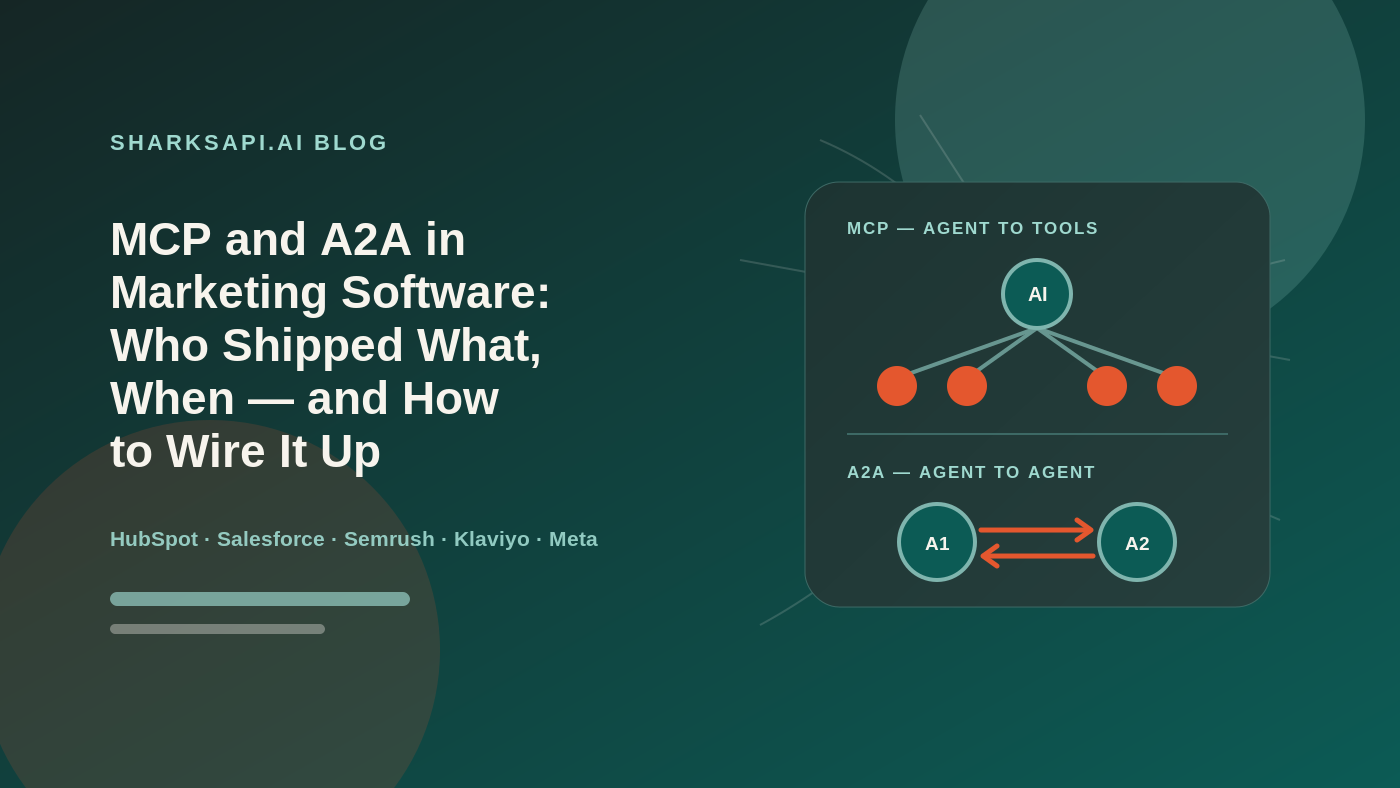
- Agent-to-Agent Protocols (A2A): Standardize how agents communicate with each other, enabling multi-agent collaboration.
- Model Context Protocol (MCP): Provides a standardized way for agents to discover and use tools.
Getting Started
Transitioning from traditional API integrations to agent-based integration does not require a complete rewrite. Start by identifying your most maintenance-heavy integrations, the ones that break frequently or require constant updates. These are ideal candidates for agent replacement.
SharksAPI.AI provides a platform where you can deploy AI agents that connect to 35+ marketing and business tools out of the box, with the ability to add custom integrations through natural language configuration rather than code.
The future of integration is not about writing more API code; it is about teaching agents to handle integration intelligently and autonomously.