The way software systems communicate is undergoing a fundamental transformation. While traditional APIs have served us well for decades, the rise of autonomous AI agents demands a new paradigm: Agent-to-Agent (A2A) communication protocols. This shift is not incremental — it represents a complete rethinking of how digital services discover, negotiate, and collaborate with each other.
At SharksAPI.AI, we have been at the forefront of this revolution, building infrastructure that enables AI agents to seamlessly interact through standardized protocols. In this deep dive, we explore what A2A means for your business and why it matters now more than ever.
What Is Agent-to-Agent (A2A) API?
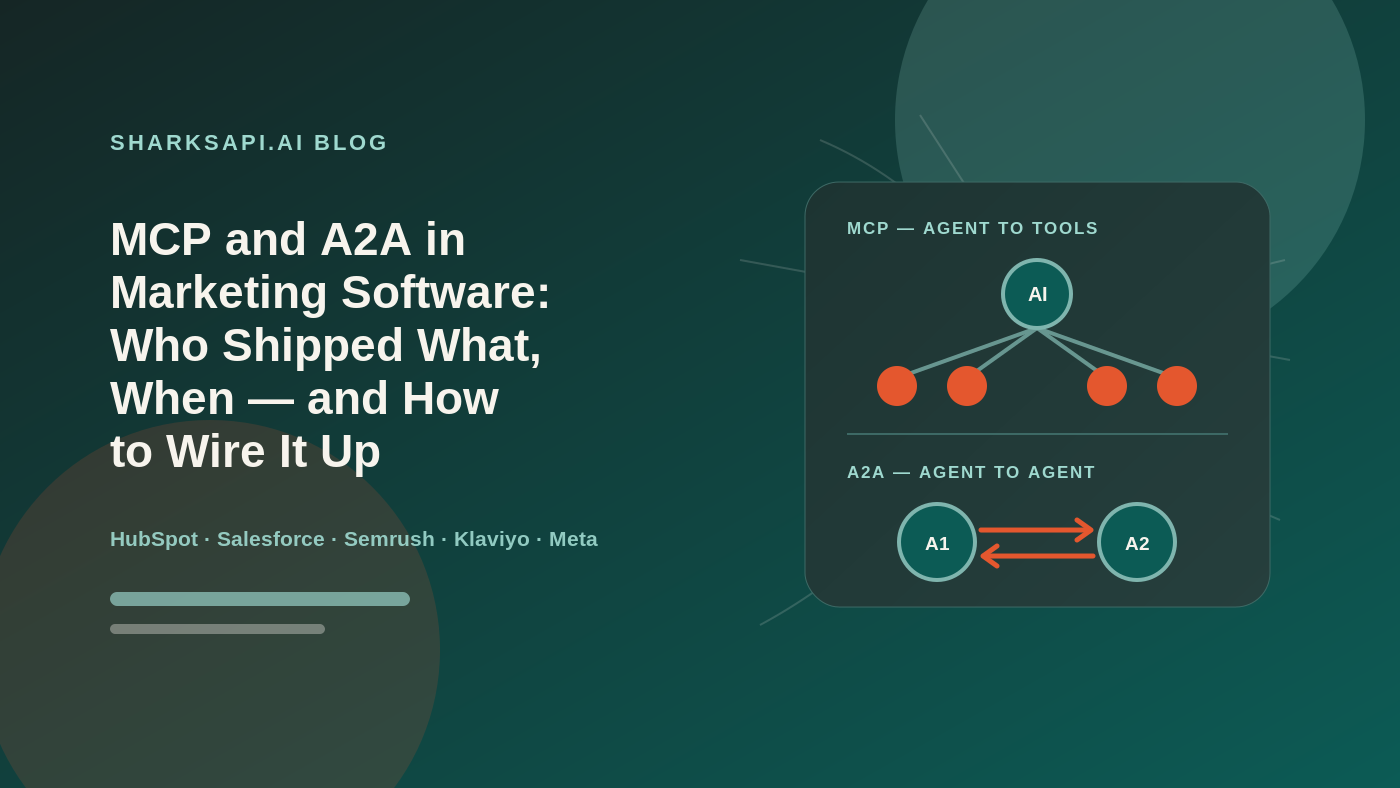
Agent-to-Agent API is a communication protocol designed specifically for autonomous AI agents to interact with each other without human intervention. Unlike traditional APIs where a human developer writes code to call an endpoint, A2A enables agents to:
- Discover capabilities — Agents can browse and understand what other agents offer through machine-readable capability manifests
- Negotiate terms — Agents autonomously agree on data formats, pricing, rate limits, and service-level agreements
- Execute tasks collaboratively — Multiple agents coordinate complex workflows spanning different domains
- Learn and adapt — Agents improve their interaction patterns based on outcomes and feedback loops
“A2A is to AI agents what HTTP was to web browsers — the foundational protocol that unlocks an entirely new ecosystem of autonomous collaboration.”
A2A Market Growth: The Numbers Speak
The A2A protocol market has experienced explosive growth over the past four years, and projections suggest this is only the beginning.
A2A is moving from a developer topic into an operating layer for agent work. Understanding how A2A compares to other protocols is essential — see our comprehensive comparison of MCP, REST, and GraphQL for AI agent integration. Businesses that delay adoption risk falling behind competitors who leverage autonomous agent collaboration for speed, cost reduction, and innovation.
Traditional API vs Agent API vs A2A Protocol
| Feature | Traditional API | Agent API | A2A Protocol |
|---|---|---|---|
| Communication | Human-initiated requests | Agent-initiated, human-supervised | Fully autonomous agent-to-agent |
| Discovery | Manual documentation reading | Schema-driven (OpenAPI) | Dynamic capability manifests |
| Negotiation | None (fixed contracts) | Limited parameter adjustment | Full autonomous negotiation |
| Error Handling | HTTP status codes | Contextual error resolution | Self-healing with fallback agents |
| Scalability | Load balancer dependent | Agent pool scaling | Swarm-based auto-scaling |
| Best For | CRUD operations, web apps | AI-enhanced workflows | Fully autonomous business processes |
How A2A Works: The Protocol Stack
The A2A protocol operates on a layered architecture that ensures reliability, security, and interoperability:
1. Discovery Layer
Agents publish their capabilities using standardized Agent Cards — machine-readable JSON-LD documents that describe what the agent can do, what inputs it accepts, and what outputs it produces. Think of it as an automated business card that other agents can parse and understand instantly.
2. Negotiation Layer
Before executing a task, agents negotiate terms through a structured handshake protocol. This includes agreeing on data formats, authentication mechanisms, response timeframes, and cost structures. The negotiation is fully automated but can be constrained by policies set by the agent operators.
3. Execution Layer
Tasks are executed through asynchronous message passing, with built-in support for streaming results, progress updates, and partial deliveries. The execution layer supports both synchronous request-response patterns and long-running task workflows.
4. Trust and Verification Layer
Every interaction is cryptographically signed and verifiable. Agents build reputation scores based on their track record, and trust relationships can be established through decentralized identity mechanisms.
Real-World A2A Use Cases
A2A is already transforming how businesses operate across multiple industries:
- Supply Chain Automation: Procurement agents negotiate with supplier agents to find optimal pricing, delivery times, and quality guarantees — all without human intervention.
- Financial Trading: Trading agents coordinate with risk assessment agents and compliance agents to execute complex financial strategies in real time.
- Healthcare Coordination: Diagnostic agents consult with specialist agents, pharmacy agents, and insurance agents to streamline patient care pathways.
- Marketing Orchestration: Content creation agents collaborate with SEO agents, distribution agents, and analytics agents to run complete marketing campaigns autonomously.
Getting Started with A2A on SharksAPI.AI
SharksAPI.AI provides a complete A2A infrastructure that lets you deploy, manage, and monitor agent-to-agent interactions at scale. Our platform supports:
- Agent discovery and registry with capability matching
- Secure agent-to-agent communication channels
- Built-in monitoring and analytics dashboards
- Policy-based governance for autonomous interactions
- Seamless integration with existing REST and MCP protocols
Ready to build your first A2A integration? Sign up for SharksAPI.AI and start connecting your agents today.
The Road Ahead
As we move into the second half of 2026, the A2A ecosystem is poised for even greater expansion. Our 2026 AI Agent Market Report highlights the key trends driving this growth. Standards bodies are working on formal specifications, major cloud providers are integrating A2A support into their platforms, and the developer tooling ecosystem is maturing rapidly.
The businesses that embrace A2A today will be the ones leading their industries tomorrow. The question is no longer if you should adopt A2A, but how quickly you can get started.