Choosing the right communication protocol for AI agent integration is one of the most consequential technical decisions you will make in 2026. With the proliferation of AI agents across enterprise systems, the protocol you select determines your system's performance, flexibility, and future scalability.
In this comprehensive guide, we break down three dominant protocols — MCP (Model Context Protocol), REST, and GraphQL — and help you understand when to use each one for AI agent integrations.
Protocol Overview
MCP (Model Context Protocol)
MCP is purpose-built for AI. Developed to standardize how AI models connect to external data sources and tools, MCP provides a structured way for agents to access context, execute functions, and receive results. It uses a JSON-RPC based messaging format optimized for the request patterns typical of AI agent interactions.
REST (Representational State Transfer)
REST remains the most widely deployed API paradigm on the internet. Built on HTTP methods (GET, POST, PUT, DELETE), REST is resource-oriented and stateless. Its simplicity and ubiquity make it a natural choice for many integrations, though it was not designed with AI agents in mind.
GraphQL
GraphQL offers a query language that lets clients request exactly the data they need in a single request. Its strongly typed schema and introspection capabilities make it attractive for complex data requirements, though the overhead of query parsing can be a consideration for high-frequency agent interactions.
Visual Comparison
Performance Benchmarks
We ran standardized benchmarks simulating common AI agent interaction patterns. Here are the results across key metrics:
| Metric | MCP | REST | GraphQL |
|---|---|---|---|
| Avg. Response Time (simple query) | 12ms | 8ms | 18ms |
| Avg. Response Time (complex query) | 25ms | 45ms (multiple calls) | 32ms |
| Payload Efficiency | 92% | 65% | 95% |
| Streaming Support | Native (SSE + WebSocket) | SSE only | Subscriptions (WebSocket) |
| Tool/Function Calling | Native | Via custom endpoints | Via mutations |
| Context Window Management | Built-in | Manual implementation | Manual implementation |
When to Use Each Protocol
Choose MCP When:
- You are building AI-native applications where agents need to access tools and data sources
- Streaming responses and real-time context updates are critical
- You need standardized tool/function calling capabilities
- Your agents require dynamic context window management
- Interoperability between different AI models and providers is a priority
Choose REST When:
- You are integrating with existing systems that already expose REST APIs
- Your interactions are simple CRUD operations with well-defined resources
- Caching at the HTTP layer is important for performance
- Your team has deep REST expertise and the learning curve matters
- You need maximum ecosystem support (libraries, middleware, monitoring tools)
Choose GraphQL When:
- Your agents need to query complex, nested data structures efficiently
- Minimizing over-fetching and under-fetching is critical for performance
- You want a strongly typed schema that serves as a contract and documentation
- Multiple agent types need different views of the same underlying data
- You are building a unified API layer over multiple microservices
The Hybrid Approach: Best of All Worlds
In practice, most production AI agent systems use a combination of protocols. Here is a common architecture pattern we see at SharksAPI.AI:
- MCP for agent-to-model communication (context injection, tool calling, streaming)
- REST for infrastructure operations (deployment, monitoring, configuration management)
- GraphQL for complex data queries (analytics dashboards, reporting, multi-entity lookups)
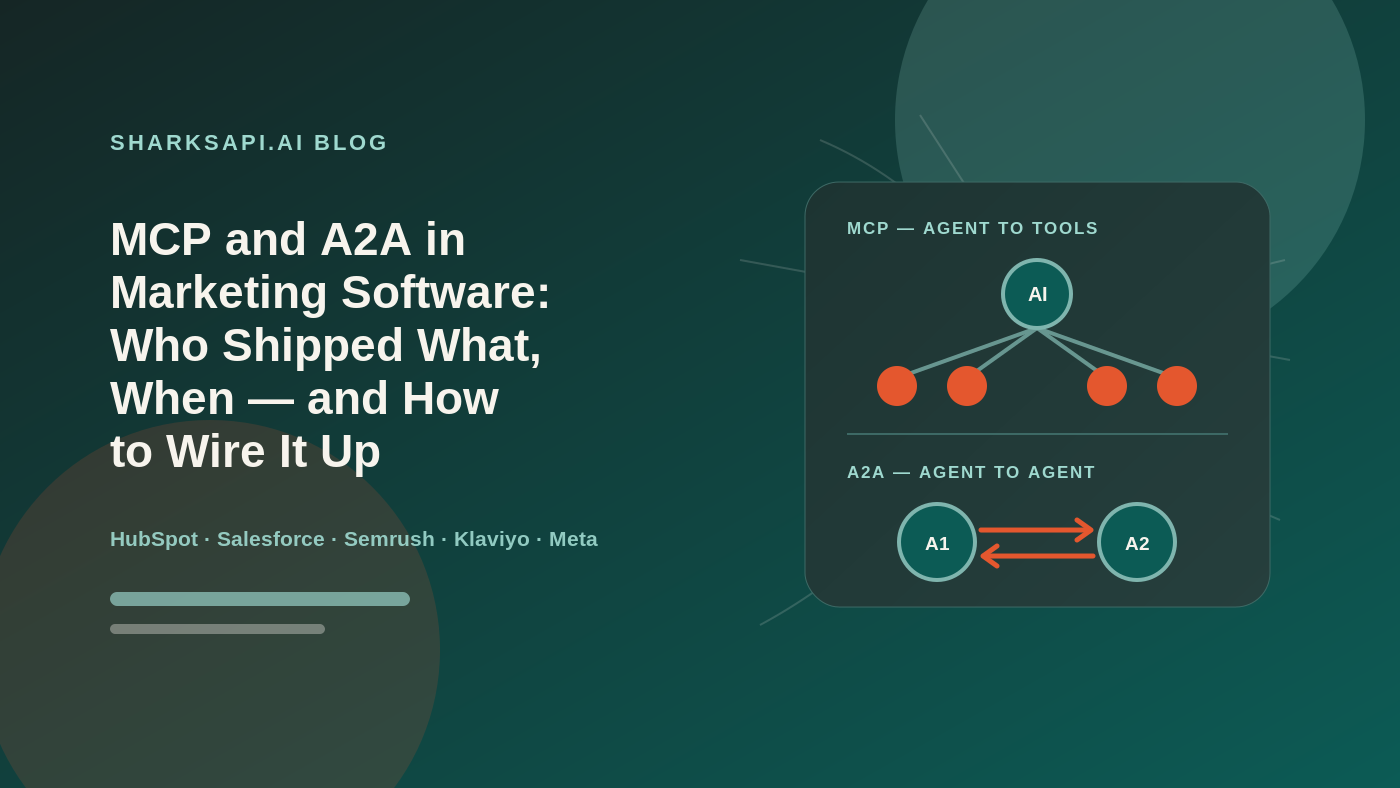
- A2A for agent-to-agent collaboration (task delegation, capability discovery) — learn more in our deep dive on the Agent-to-Agent protocol
“The best protocol is the one that matches your interaction pattern. Do not force a protocol where it does not naturally fit.”
Migration Strategies
If you are considering adding MCP to an existing REST or GraphQL infrastructure, here are proven strategies:
Strategy 1: MCP Gateway
Deploy an MCP gateway that translates between MCP and your existing APIs. This allows your AI agents to communicate via MCP while your backend services remain unchanged. SharksAPI.AI offers a managed MCP gateway that handles this translation automatically.
Strategy 2: Gradual Adoption
Start by implementing MCP for new agent capabilities while keeping existing integrations on REST/GraphQL. Over time, migrate high-value interactions to MCP as the benefits become clear.
Strategy 3: Protocol Abstraction Layer
Build a protocol-agnostic abstraction layer that lets your agents interact through a unified interface, regardless of the underlying protocol. This provides maximum flexibility and reduces lock-in to any single protocol.
Looking Forward
The protocol landscape for AI agents continues to evolve rapidly. According to our 2026 AI Agent Market Report, MCP adoption is projected to reach 60% among enterprises by year-end. MCP is gaining adoption at an accelerating pace, with major AI providers now offering native MCP support. REST remains indispensable for general-purpose integrations, and GraphQL continues to excel for complex data access patterns.
The key takeaway: understand the strengths of each protocol and apply them where they deliver the most value. Your AI agent infrastructure will be most effective when you leverage the right tool for each job.