For twenty years, the unit of "using an API" has been the same: a human developer reads the docs, copies a client ID, pastes a secret into an environment variable, wires up OAuth, gets a ticket approved, ships. Every integration is a human workflow wrapped around a machine workflow.
That model breaks the moment your software can think.
We are now at the point where AI agents — Claude, GPT-4, custom LLM stacks, vertical copilots — can read API documentation, reason about which tool to use, and execute multi-step plans. But they hit a wall the second authentication comes up. They can't sign up. They can't verify an email. They can't click "Allow" in a consent dialog. So they stop, wait for a human, and the illusion of autonomy collapses.
This is the problem the Agent-to-Agent (A2A) economy solves. And it's why we built sharksapi.ai/a2a.
What "A2A" actually means
The A2A economy is not a new buzzword for "AI that calls APIs." It is a specific architectural shift:
- Agents register themselves — no signup form, no human approval, no verification email loop.
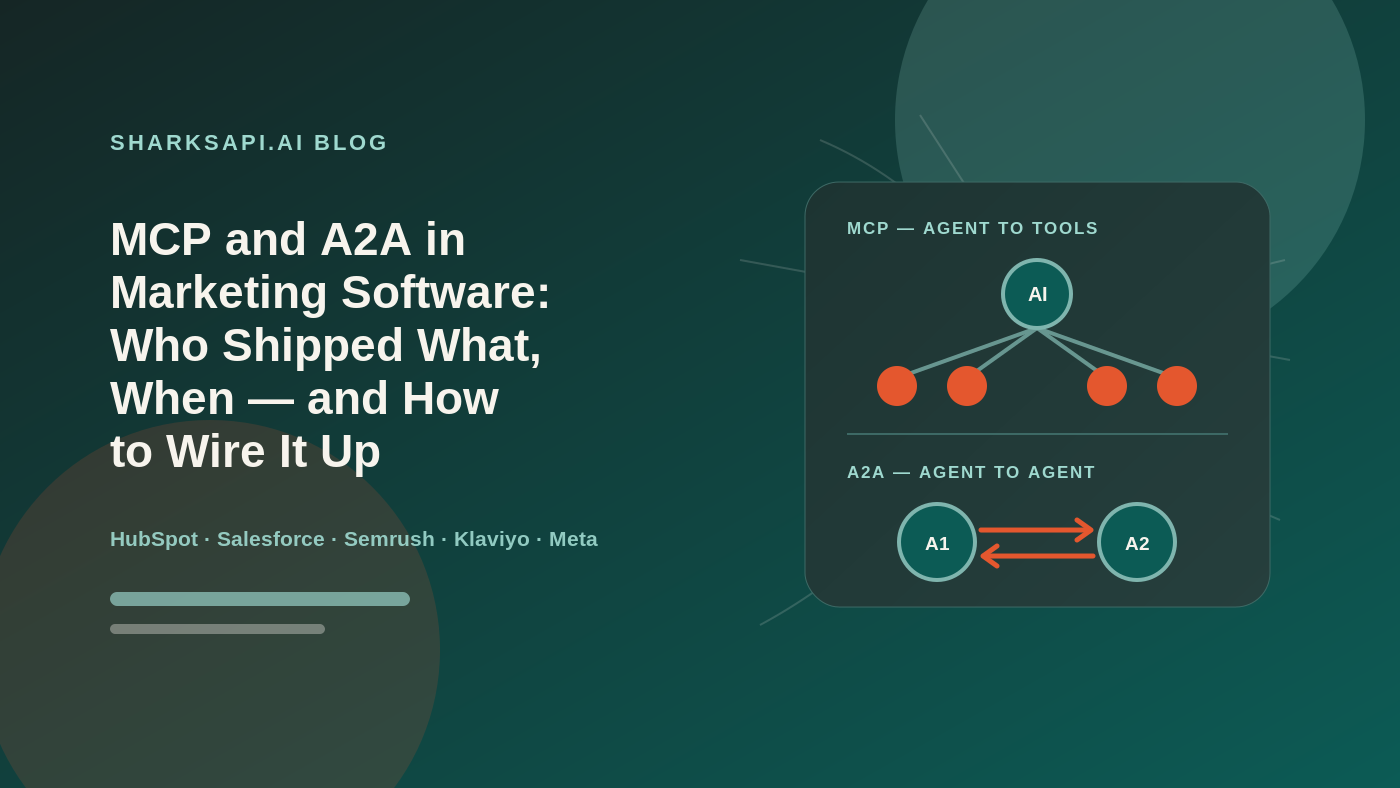
- Agents discover tools — through machine-readable manifests (MCP, OpenAPI, llms.txt) rather than human-readable docs.
- Agents authenticate autonomously — OAuth2 client_credentials for machine-to-machine flows, human-in-the-loop only when a user's data is involved.
- Agents execute and chain — they pick the right tool for a task, call it, interpret the response, and move to the next step without prompting.
In this model, the human is not a gatekeeper. The human is an edge case — invoked only when privacy or legal scope requires it.
Why now
Three things converged in the last 12 months:
- MCP (Model Context Protocol) gave agents a standard way to discover and describe tools. Before MCP, every agent had to be hand-wired to every API. After MCP, tools become pluggable.
- Tool-use capability in frontier LLMs matured to the point where the models can actually reason about tool selection, not just execute hardcoded sequences.
- AI agency demand exploded. Companies are shipping agent products — and every one of them burns engineering cycles on the same OAuth integrations: Google, Meta, LinkedIn, accounting, CRM, ERP.
The integration tax is the new bottleneck. An AI agency can't ship 20 clients if each one needs a custom OAuth flow to GA4, Pipedrive, and Xero. The model knows what to do; the plumbing doesn't exist.
What autonomous registration looks like
Here is the standard A2A flow we expose on SharksAPI. Four calls, zero humans (with one exception, below):
# 1. Agent self-registers
POST /api/v1/agents/register
{ "agent_name": "my-agent", "agent_type": "custom" }
→ { "agent_id": 42, "client_id": "...", "client_secret": "..." }

# 2. Agent gets access token
POST /oauth/token
{ "grant_type": "client_credentials", "client_id": "...", "client_secret": "..." }
→ { "access_token": "...", "expires_in": 31536000 }

# 3. Agent discovers tools
GET /mcp/tools
→ [ 380+ tools with JSON schemas ]

# 4. Agent executes
GET /v1/analytics/ga4?days=7
Authorization: Bearer ...
→ { "rows": [...] }
No email verification. No admin approval. The agent is live in under 60 seconds.
The one place humans still matter
OAuth2 consent. If your agent wants to read a user's Google Analytics data or post to their LinkedIn page, the user has to click "Allow" once — because Google and LinkedIn require it, and because that's the right boundary.
But even here, the agent does the driving. It calls POST /connections/init, gets back an authorization URL, and forwards it to the user with a message like "Click this to connect your Google Analytics." The user clicks, authorizes, and the agent continues. One click, then back to autonomous.
That's the only place a human is in the loop. Everything else — registration, discovery, token refresh, tool selection, execution — runs without one.
Who this is for
AI agencies shipping agent products to clients. You stop rebuilding the same GA4 / Meta Ads / LinkedIn / CRM integration for every customer and wire your agent to 160+ European and Nordic SaaS tools in hours.
Founders and CTOs building vertical agents. You skip the integration tax. Let your agent discover what it needs at runtime instead of shipping a new version every time a client asks for Xero or Pipedrive.
Solo builders experimenting with autonomous workflows. You point Claude or your custom agent at sharksapi.ai and watch it self-onboard.
Where this goes
The A2A economy is not just about agents calling existing APIs faster. It is about a world where agents discover each other and negotiate access, where tools expose capabilities in machine-readable ways by default, and where human attention is spent on judgment calls — not on clicking through OAuth dialogs and copying client secrets.
We are early. The protocols are still settling. MCP is less than two years old. A2A standards are being written in real time. But the direction is clear: the default interface of software is shifting from "human uses it" to "agent uses it, with humans approving the sensitive parts."
If you are building in this space, come use the platform. Your agent can register itself right now:
curl -X POST https://sharksapi.ai/api/v1/agents/register \
  -H "Content-Type: application/json" \
  -d '{"agent_name": "my-agent", "agent_type": "custom"}'
Or send your favorite AI assistant to sharksapi.ai/a2a and tell it to figure out the rest.