Anthropic has been quietly building something transformative: the Model Context Protocol (MCP). While other companies focus on making models smarter, Anthropic is solving a more fundamental problem: how do AI agents reliably discover, understand, and use external tools?
The Tool Use Problem
Every AI agent needs to interact with external systems, databases, APIs, file systems, and other services. But until MCP, there was no standard way for agents to:
- Discover what tools are available
- Understand how to use them correctly
- Handle errors and edge cases
- Maintain security and access control
Each agent framework invented its own approach, creating fragmentation and interoperability nightmares. MCP changes this by providing a universal protocol for tool interaction.
How MCP Works
MCP operates on a client-server architecture where:
MCP Servers
An MCP server exposes capabilities that agents can use. These capabilities fall into three categories:
- Tools: Functions the agent can call, like searching a database or sending an email.
- Resources: Data the agent can read, like files, documents, or configuration.
- Prompts: Pre-defined prompt templates that help the agent use tools effectively.
MCP Clients
AI agents act as MCP clients. They connect to MCP servers, discover available capabilities, and invoke them as needed during task execution. The client handles protocol negotiation, authentication, and result parsing.
The Discovery Process
When an MCP client connects to a server, it receives a capability manifest describing all available tools with their parameters, return types, and usage instructions. This is similar to OpenAPI for REST APIs, but designed specifically for AI agent consumption.
Why MCP Is Winning
Several factors are driving MCP adoption across the industry:
- Model Agnostic: Despite being created by Anthropic, MCP works with any AI model. OpenAI, Google, and open-source models can all act as MCP clients.
- Growing Ecosystem: Over 2,000 MCP servers are now available, covering everything from GitHub and Slack to databases, cloud services, and enterprise applications.
- Security First: MCP includes built-in authentication, authorization, and audit capabilities, critical for enterprise adoption.
- Simplicity: Building an MCP server is straightforward. A basic server can be created in under 50 lines of code.
MCP in the A2A Context
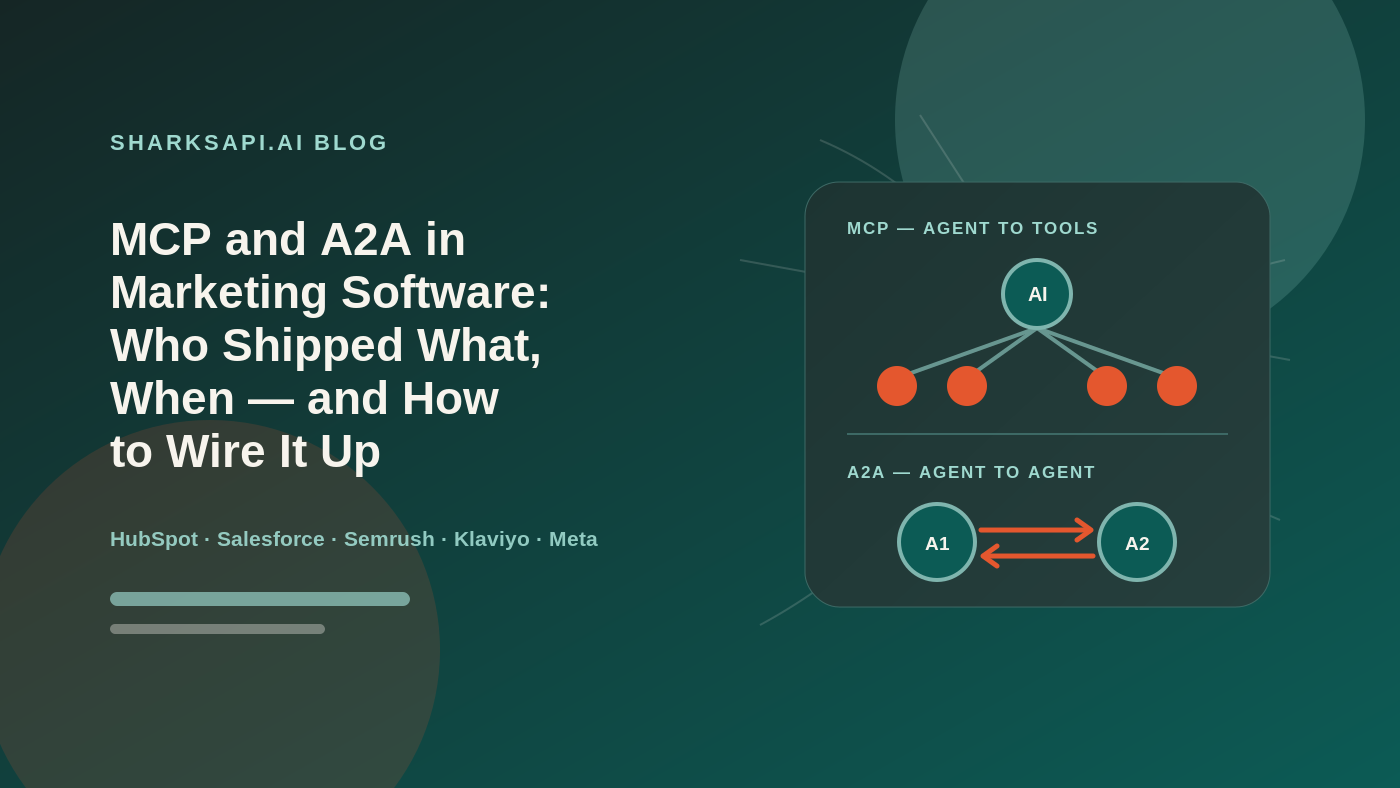
MCP and A2A are complementary protocols. MCP handles tool use (how an agent interacts with services), while A2A handles agent-to-agent communication (how agents interact with each other). Together, they form a complete protocol stack for autonomous AI systems:
- A2A: Agent discovers and delegates tasks to other agents
- MCP: Each agent uses MCP to interact with its tools and data sources
SharksAPI.AI supports both protocols natively, allowing you to build systems where agents collaborate via A2A while each agent uses MCP to access the specific tools it needs.
Building with MCP
Getting started with MCP is straightforward. The official SDKs are available for Python and TypeScript, with community implementations in Go, Rust, and Java:
from mcp.server import Server
from mcp.types import Tool

server = Server("my-mcp-server")

@server.tool()
async def search_products(query: str, category: str = None) -> list:
    """Search the product catalog by keyword and optional category."""
    results = await db.products.search(query, category=category)
    return [{"name": r.name, "price": r.price} for r in results]

# Start the server
server.run(transport="stdio")
The Future of MCP
The MCP specification continues to evolve. Upcoming features include:
- Streaming tools: Support for tools that return results incrementally
- Composite tools: Tools that combine multiple sub-tools into higher-level operations
- Remote MCP servers: Standardized HTTP transport for cloud-hosted MCP servers
- Tool marketplace: A centralized registry for discovering and sharing MCP servers
MCP is becoming the HTTP of the AI agent world: a foundational protocol that everyone builds on. Whether you are building agents with Claude, GPT, Gemini, or open-source models, understanding MCP is essential for any developer working in the agent space.